Energy & Wealth: What We’re Hearing from the World’s Most Sophisticated Allocators
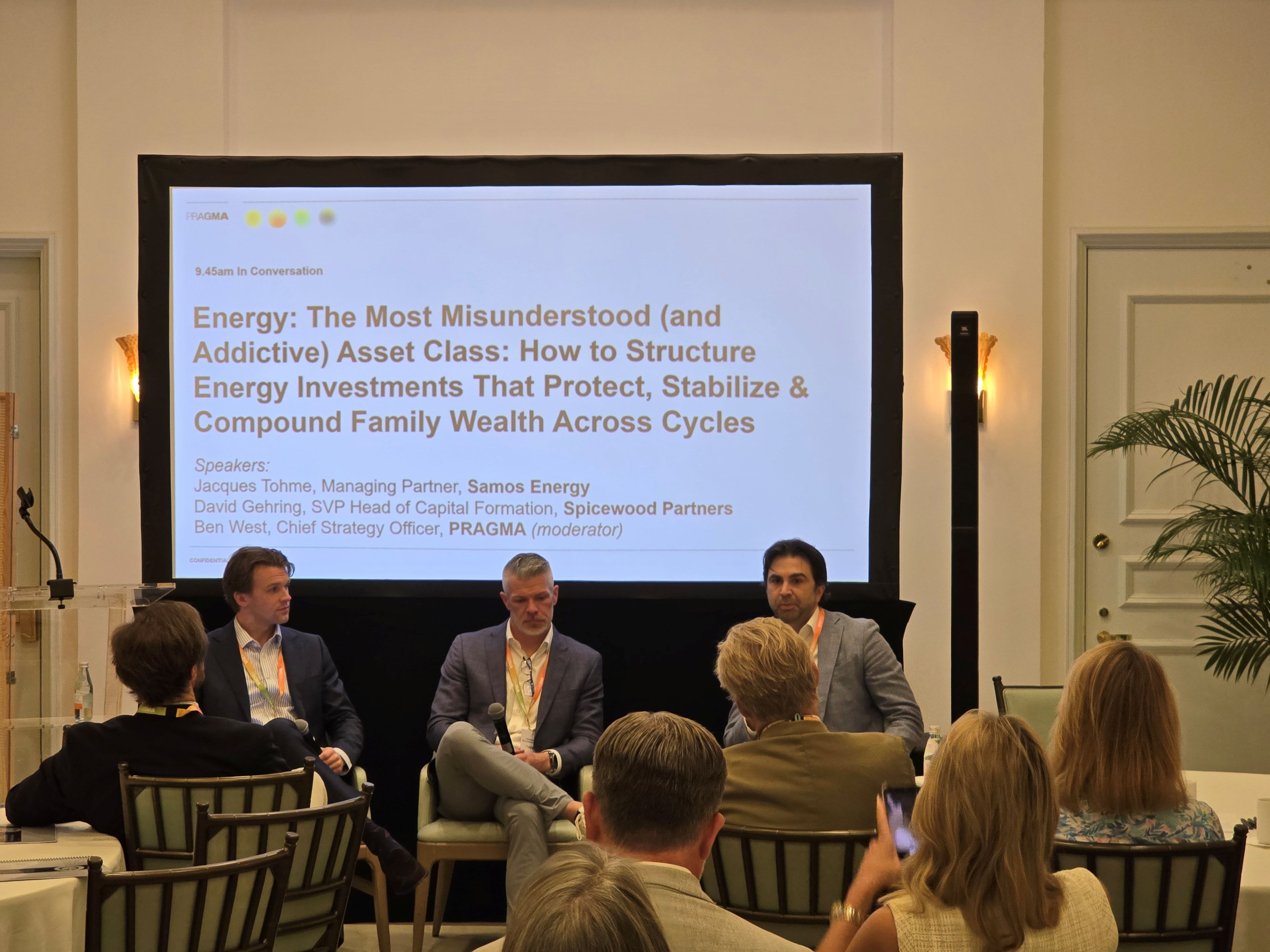
In the month of April, we hosted a series of private family office events across Florida and Dallas as part of PRAGMA’s LP & Family Office International Energy Series.
These sessions titled “Energy & Wealth: Unlocking Stability, Liquidity & Growth”, brought together a highly curated group of family offices, institutional LPs, operators, and capital providers to discuss one central question: How should energy be positioned within a modern portfolio?
The agenda spanned three core areas:
A macro outlook shaped by geopolitics and commodity volatility
The discussion focused on how global events are directly influencing energy markets and, in turn, broader portfolios. Ongoing geopolitical tensions and tighter supply conditions are feeding into oil and gas prices, which are then impacting inflation, interest rates, and overall risk sentiment. Energy is no longer viewed in isolation. It is now a key driver of how allocators think about positioning across asset classes.
Portfolio construction across oil, gas, and power
Rather than treating energy as a single category, investors are increasingly breaking it into oil, gas, and power, each with its own risk and return profile. The conversation centered on how to balance income, resilience, and upside across these areas, and how energy compares to other parts of the private markets portfolio that are competing for capital.
Structuring, liquidity, and governance as the drivers of outcomes
Emphasis is being placed on how investments are put together and not just what is being invested in. Investors are spending more time thinking about cash flow timing, alignment with managers, downside protection, and tax efficiency. The structure of a deal, the way capital is deployed, and the level of control investors have are increasingly what determine the end result.
In these conversations, it became evident that how investors are thinking about energy has not caught up to how the market is evolving.
A More Disciplined Supply Story, but an Uncertain Demand Future
From the discussions that took place, a key takeaway is that the tone around supply has changed.
Operators today are more measured, and capital discipline is embedded in the framework of how businesses are run. Activity is no longer driven by short term price spikes but by confidence in a sustained pricing environment. Enhancements in technology is also quietly reshaping the supply picture. Improvements in recovery rates and operational efficiency are increasing what can be extracted from existing resources.
By contrast, the less settled debate is around demand.
There is a growing divergence in how investors think about the future:
• How quickly the energy transition will unfold
• The extent to which AI and electrification will influence demand
• Whether affordability and reliability ultimately outweigh decarbonisation goals
The undeniable global reality is that rising standards of living for billions continue to drive aggregate energy demand higher, regardless of the source.
But further out, the picture becomes less clear. The combination of technological change, policy shifts, and evolving consumption patterns introduces real uncertainty.
Sophisticated underwriting now hinges on balancing robust near-term demand against the risk of long-term disruption. Execution now focuses on immediate yields and shorter payback cycles, de-emphasizing long-term price assumptions and exit-driven returns. It also means stress testing assets across a range of demand scenarios and prioritising flexibility over single path conviction.
AI, Power, and the Scale of What Is Coming
If there was one area where conviction was strongest, it was around power.
AI is not being viewed as a short-term catalyst, but as a structural driver of energy demand that is likely to play out over the next decade or more. This is translating into a rapid buildout of data centers, generation capacity, and the broader infrastructure required to support it.
As a result, capital is moving into the space quickly. Development pipelines are expanding, in some cases faster than the underlying system can support, with constraints beginning to emerge across equipment, grid access, and permitting.
Data centers are increasingly being approached like real estate developments. Projects move forward once there is an anchor tenant and a clear path to monetisation, but they still require significant upfront capital and disciplined execution. In several markets, the volume of proposed projects already points to a gap between what is planned and what is ultimately delivered.
The long-term demand story is compelling, but it is not without risk. Strong conviction tends to attract capital, and when capital moves too quickly, it can lead to overbuilding and mispricing.
Tax Alpha Is Foundational, Not Incremental
While the macro backdrop continues to evolve, one point came through clearly across the discussions: the edge in energy today is not just about where you invest, but how you structure and underwrite the investment.
A consistent gap remains in how opportunities are evaluated. Many investors still focus on pretax returns, underwriting deals in isolation and treating tax benefits as an added bonus. The more sophisticated approach focuses on what the investor actually keeps.
That shift changes behaviour. Instead of chasing headline IRRs, investors are designing exposures around after-tax cash flow, timing of distributions, and how income is classified. Tools like intangible drilling costs, depletion allowances, and the distinction between active and passive income are not just technical features, they are core to how returns are generated.
This also means thinking beyond a single deal. Portfolio pacing, the mix between minerals and working interests, and how capital is deployed over time all become part of the return equation. Two investors in the same well can end up with meaningfully different after-tax outcomes.
This is why tax should not be viewed as incremental, and instead should be considered as a primary lever that separates an average outcome from a highly efficient one.
Why Portfolio Role and Structure Now Go Hand in Hand
A key part of the discussion looked at how investors are thinking much more deliberately about how that exposure is built.
In a market where many strategies rely on exits to generate returns, energy offers something fundamentally different. It can provide current cash flow, embedded tax efficiency, and real asset exposure without depending on a future liquidity event. That has led to a reframing of its role, from a cyclical or opportunistic allocation to something more foundational. Some investors are using energy as a stabilising component within portfolios, a hedge against inflation, and a consistent source of income.
But that shift in positioning is only part of the story. What ultimately determines outcomes is how that exposure is structured.
Small differences can have a meaningful impact. The choice between minerals and working interests, equity and credit, or how income is classified can materially change both the return profile and the risk characteristics. Even the pacing of capital deployment plays a role in shaping results over time.
This is where the two ideas converge. As energy becomes more central to portfolio construction, investors are placing greater emphasis on designing their exposure with intention. The focus is on building it in a way that aligns with broader portfolio objectives.
Energy is becoming a more permanent part of portfolios, not just something investors move in and out of. The difference now is how it is approached, with more focus on structure, cash flow, and selectivity.
There is still uncertainty around where demand goes from here, and capital is moving quickly into certain areas. But the investors getting it right are the ones staying disciplined in how they put money to work.



.png)